

This image shows Earth at the bottom with bright, swirling streams of luminous energy extending upwards into space. These energy streams glow in vibrant shades of blue, purple, and gold, twisting and intertwining as they reach into a backdrop filled with numerous stars, galaxies, and cosmic dust. The dark space is rich with sparkling celestial bodies, evoking the vastness of the universe and the dynamic connection between Earth and cosmic forces.
St. John Eudes: The Liturgical and Ecclesial Foundation.
Two Frenchmen, separated by nearly three centuries, share an origin in French Catholic Piety and a passionate devotion to the Sacred Heart. They are St John Eudes (1601 – 1680) and Teilhard de Chardin (1881 – 1995). They present us with two visions of the Sacred Heart. However, their theological frameworks, purpose, and cosmic horizons are strikingly different. St John Eudes gave us a liturgical and ecclesial framework. In 1648 St John Eudes wrote the first Mass and Divine Office in honour of the Immaculate Heart of Mary, and in 1672, he composed the first Mass and Office in honor of the Sacred Heart of Jesus. Influenced by the French School of Spirituality, John Eudes joined a movement that promoted a Christocentric approach. This was characterized by a strong sense of adoration and a pursuit of a personal relationship with Jesus Christ. A distinctive mark of John Eudes was his inseparable linking of the Heart of Jesus and Mary. He taught that Jesus continues His Incarnation in the life of each baptized Christian. His central theme was that the Christian life is a continuation of Christ’s life. The Sacred Heart was a ‘remedy for sin’, the font of mercy, and a model for personal holiness expressed within and through the structures of the Church and its sacraments. For St John Eudes, the Sacred Heart of Jesus combined “three loves”: the divine, uncreated love of Christ; the human love of Jesus, proceeding through His human will; and the sensible and emotional love of Jesus, symbolized by the heart of flesh.
Teilhard de Chardin: From Devotion to Cosmic Vision.
Devotion to the Sacred Heart of Jesus was instilled in Teilhard de Chardin by his mother, Bertha de Dompierre. Teilhard did not leave the devotion in its sentimental form but made a significant contribution to the formation of a mature devotion to the Sacred Heart. Teilhard rescued the devotion from sentimentality and superstition, integrating it into his vision of the universe.
For Teilhard, the cosmic Christ was born from the Sacred Heart. Teilhard took the image of the Sacred Heart and extended it to the entire cosmos, which Teilhard envisioned as the living, beating, evolutionary love of Christ. “It is in the Sacred Heart that the conjunction of the Divine and the cosmic has taken place…There lies the power that, from the beginning, has attracted me and conquered me…All the later developments of my interior life have been nothing other than the evolution of that seed.”1
Teilhard wrote, “Someday, after mastering the winds, the waves, the tides, the gravity, we will harness for God the energies of love. And then for the second time humankind will have discovered fire.”2
The cosmic Christ came to him as “an expansion of the heart of Jesus.” In 1950, he added: The Sacred Heart is the heart of the heart of the world, the center of the center of the universe. Teilhard’s language became increasingly cosmic over his lifetime. In 1940, Teilhard journaled: “The Sacred Heart is the personal heart of the cosmos…the origin of evolution.”
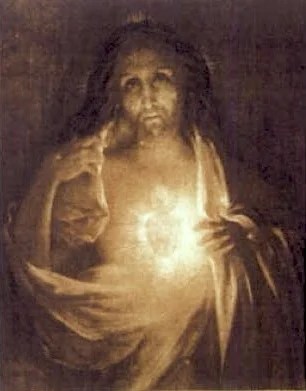
Teilhard was a mystic. One of his first mystical experiences, called “The Picture,” took place in a church, where he gazed at a portrait of Jesus offering his heart to humankind. Teilhard recounts that the outlines of Jesus’ figure, although originally solid, gradually seemed to dissolve, and all seemed to merge, as it were (thought without vanishing away), into the rest of the picture. It was as though the planes that marked off the figure of Jesus from the surrounding world were melting into a single vibrant surface where all demarcations and separations vanished. Here was a vision that began with the image and presence of Jesus and ended with an image of the Cosmic Christ.
He wrote down his own personal prayer on a holy card of the Sacred Heart, which he carried with him. It is not a traditional picture of a blood-red physical heart, but rather a softly glowing heart radiating white light.
The World-Zest,
The essence of all energy,
the comic curve
the heart of God,
The issue of cosmogenesis.
The tide of cosmic convergence,
The God of Evolution,
The universal Jesus,
Focus of ultimate and universal energy,
Center of the cosmic sphere of consmgenesis,
Heart of Jesus,
Heart of Evolution,
Unite me to yourself.3
Ilia Delio and the Christogenesis of Love
A third contributor to these insights into the Sacred Heart is Ilia Delio. Delio carries this forward through her Franciscan theology which emphasizes the Incarnation of the love of God made visible in the world. It did not consider the incarnation foremost as a remedy for sin but the primacy of love and the completion of creation – Christ is the redeeming and fulfilling center of the universe. Christ does not save us from creation; rather, Christ is the reason for creation. 4 Comparing a traditional approach with the Christogenesis insight, one could phrase it like this: A traditional homilist might say “The Sacred Heart reveals how much Jesus loves us,” but a Christogenesis insight might add “The Sacred Heart reveals the love-energy at the center of an unfinished universe. The Heart of Christ is not only a memory of divine love but the living future of creation, drawing all things into greater wholeness, consciousness, and communion with God.”
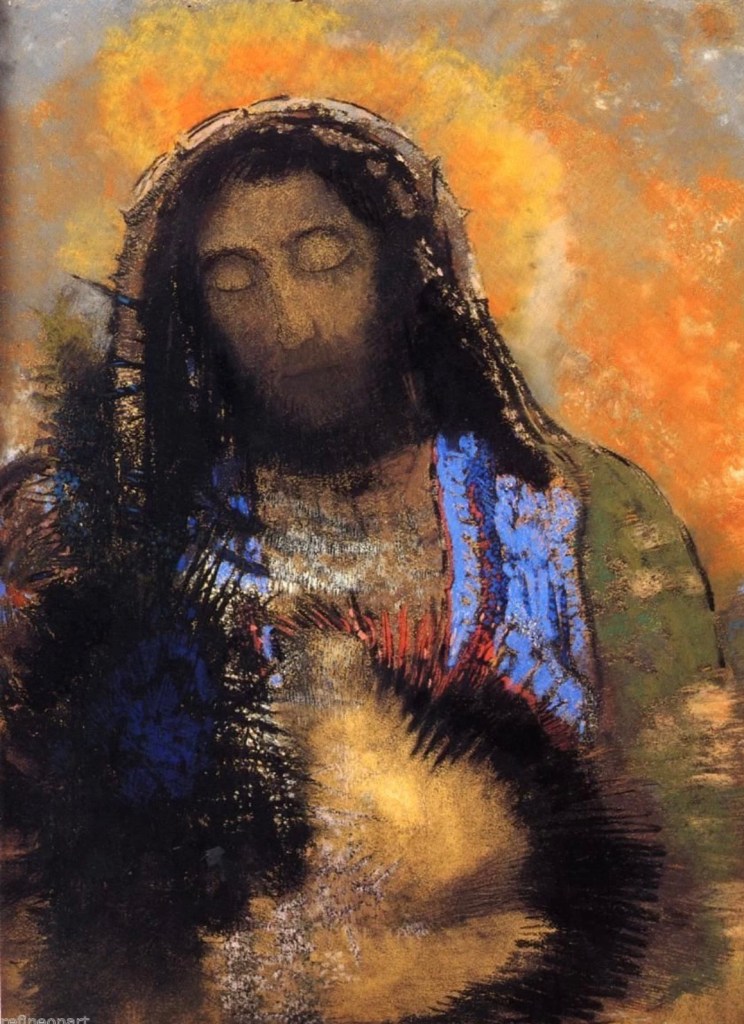
Sacred Heart by Odilon Redon (1840 – 1916), in the Musée d’Orsay, Paris, France, breaks away from the rigid traditional image of Catholic iconography, reimagining Christ as a symbol of cosmic luminous energy. The painting was completed in 1910. As Redon engaged with spiritual themes, he was likely aware of St John Eudes and the liturgical devotion to the Sacred Heart of Jesus. This image may come closest to capturing Teilhard’s vision of a dynamic unfolding cosmic process rather than a static image.



 Ancient Wisdom, Emerging Christ
Leave a comment